A Rainy-Day Desk Reset with Only What Is Nearby
A rainy-day desk reset creates a clear place to work and makes loose items easier to resume, without buying organisers or turning tidying into a project.
The common mistake in a rainy-day desk reset is trying to tidy the whole room before making space to work. That can consume the time meant for a useful task and leave the desk just as awkward to use. A better reset treats the surface as a small workbench: clear one patch, then give each displaced item a temporary landing place with a visible reason for being there.
This method is for a grey afternoon when you need the desk to function, not look finished. The aim is to make the next stretch of work easier to begin and easier to pause without losing your place.
Choose a workbench patch
Pick a patch that suits the task, such as the area in front of your chair for writing or the space beside a lamp for reading. Keep its boundary simple: the edge of a blotter, a placemat, or an imaginary line across the desk. A defined patch gives you a clear stopping point; you do not have to decide what to do with every object in the room.
Move things off the patch one at a time. Put them on a stable nearby surface, such as a chair or shelf, rather than making a tall pile that may topple or hide useful items. If a drink is near papers or electronics, move it to a separate spot. Wipe crumbs with a cloth if one is already to hand, but leave deeper cleaning for another time.
Keep the workbench patch open enough for the task you chose. A writing task needs room for a notebook and your hand; a repair may need the item and its tools laid out without crowding.
Make temporary landing zones
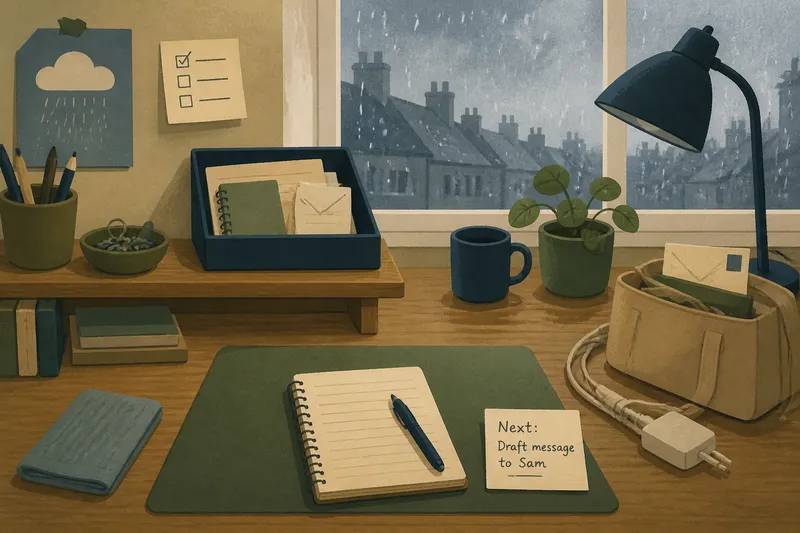
Rather than sorting the entire desk into broad categories, create a few temporary landing zones that answer different practical questions: what must stay with the current work, what needs to leave the room, and what can wait for a decision? An open tray can hold current papers; a reusable bag can gather things to carry out; a visible shelf corner can hold an item whose destination is not yet clear.
Use what is already nearby. A clean bowl may keep small loose items from rolling, while a folder can protect papers from a drink. Avoid putting away something just to make it disappear. A useful temporary home keeps the item visible, stable and easy to retrieve.
- Current work: If an item is needed for the task in progress, keep it on the patch or in an open tray beside it; otherwise, move it to another zone.
- Fragile or spill-sensitive items: If a paper or electronic device could be damaged by a nearby drink, separate them; if the desk has no safe space, move the drink before continuing.
- Items for another room: If an object has a clear destination, put it in a reusable bag or by the doorway; if its destination is uncertain, keep it visible on a shelf rather than carrying it around the room.
- Loose small objects: If several belong together and fit safely in a bowl, group them there; if the bowl would conceal or crush them, leave them spread in a visible, stable spot.
- Unclear papers: If a paper needs an immediate decision, attach a note naming the question; if it can wait, place it in an open folder rather than mixing it with current work.
- Private papers: If a document contains personal or confidential information, return it to its usual secure place; if that place is unavailable, keep it out of casual view until you can put it away properly.
Keep the work easy to resume
When you pause, leave a small handover to yourself. Keep the current materials together and add a scrap of paper with the next action if the state of the work would otherwise be hard to remember. “Continue sketch at the window” is more useful than “drawing”, because it records what to do, not just what the objects are.
Say you have a notebook, a pen, an envelope to post, a charger and a half-finished drawing on the desk, and you want to draft a message. First, clear the patch in front of your chair and put the notebook and pen there. Next, place the drawing and its pencils together on the shelf, and put the envelope in a reusable bag by the door. Then move the charger to a visible spot near its usual outlet. The result is a clear writing area, with the other items easy to find; the trade-off is that the drawing and envelope remain unfinished until their own tasks come around.
Keep temporary zones open rather than sealing or hiding them. If plans change, visible objects are easier to reconsider. Follow the normal storage instructions for any item that needs special handling, and use its usual case or folder when it must stay together with related parts.
What if the desk stays busy?
What if I cannot choose a task?
Choose a small action that makes the desk usable, such as opening a notebook or laying out one document. Leave unrelated items in visible zones, and stop once the patch is ready.
Should I organise papers by subject?
For a quick reset, first separate papers that need action from those that can wait. Once the immediate task is done, return papers that must be kept to their usual subject folder.
What can I use instead of an organiser?
An open tray, folder, clean bowl, reusable bag or clear shelf corner can serve as a temporary zone. Choose a spot that keeps its contents stable and visible.
What if I need the same item for two tasks?
Keep it with the task that is happening now, then return it to its normal place when you finish. If you will need it again soon, leave a brief note so you remember where it is.
Leave a clear handover
Before stepping away, check that the workbench patch is usable, current materials are together, and temporary items have not been hidden under a pile. Move anything with a clear destination only if doing so is straightforward; otherwise, leave it in its visible zone with a note if needed.
A rainy-day desk reset works best as a handover, not a promise to finish every loose end. Keep the landing zones small enough to inspect at a glance, and the next time you sit down you can see both where to begin and what still needs a decision.