Puns and Spoonerisms: How Two Kinds of Wordplay Turn
Puns and spoonerisms create different kinds of surprise. Learn how to shape each form, check that its turn is clear, and choose the right fit for your line.
The common mistake with puns and spoonerisms is to revise them as if they worked the same way. A pun needs a word with two useful meanings; a spoonerism needs a sound swap that leaves a recognisable source phrase. Confusing those jobs can turn a crisp line into a puzzle.
Start by deciding what the audience should notice: a second meaning, or a change in spoken sounds. That choice will guide the wording, the setting and the final edit.
Choose the wordplay
A pun draws on a double meaning or on words that sound alike but mean different things. In “The baker was short on dough”, dough refers both to bread mixture and to money. The sentence remains understandable while the second sense adds a turn.
A spoonerism exchanges sounds between words. Its success depends on an audience recognising the phrase before the sounds shifted. The altered wording should also be easy to say and worth hearing in its own right.
For example, imagine a notice for a community garden that reads, “Help us grow a greener plot.” The word plot can refer to a piece of land or to a plan, though the second sense may distract from the garden message. If the notice needs to be instantly clear, keep the literal meaning; if it is a playful caption, make the planning sense relevant in the surrounding line.
Find a strong source
For a pun, look for a word whose meanings fit the same scene. Food, gardening and music can provide useful vocabulary, but a topic alone is not enough. The second sense must belong naturally in the sentence.
Say you are writing about a gardener who is considering a new herb bed. Start with “planting an idea”. Here, planting can describe putting something in soil or introducing a thought. A line such as “She planted an idea for a smaller herb bed” keeps both senses connected to the scene.
For a spoonerism, start with a short phrase an audience is likely to know. A familiar instruction or expression gives listeners a route back to the original. Mark the spoken sounds rather than relying on spelling, then try an exchange between two words.
Imagine you begin with “busy bees” and swap the opening sounds. The result, “beasy bees”, is awkward and does not suggest a fresh image. Keep the starting phrase only if another sound change can produce clearer wording; otherwise, choose a different source.
Shape each line
Build a pun around a sentence that works before anyone notices the double meaning. Read it aloud and ask whether both senses fit the actual scene. If one requires a long explanation, change the word or the setting.
For a spoonerism, say the original phrase aloud, exchange the intended sounds, then say the altered version at a natural pace. English spelling can hide pronunciation differences, so listen for the sounds themselves. If the result is difficult to pronounce or has no clear meaning, try another pair.
A useful spoonerism also has a clear path back to its source. If several phrases could have supplied the sounds, add context that points to the intended one. Avoid adding so much explanation that the audience has to solve the line after the joke has passed.
Questions about wordplay?
What makes a pun different from a spoonerism?
A pun turns on meaning: one word has two relevant senses, or similar-sounding words create a second reading. A spoonerism turns on pronunciation, with sounds exchanged between words so the source phrase can still be recognised.
Can one line use both forms?
Yes, but each device must remain clear on its own. If the double meaning competes with the sound swap, simplify the sentence or keep only the stronger turn.
Why can a spoonerism sound awkward?
The exchanged sounds may form words that are hard to pronounce or difficult to understand. Try a shorter, more familiar source phrase and listen to the altered version at an ordinary speaking pace.
How can I tell if a pun is forced?
Read the sentence without drawing attention to the double meaning. If the wording sounds unnatural or the second sense does not fit the scene, revise the setup or choose another word.
Revise with purpose
Check the line against the kind of wordplay you chose. For a pun, ask whether both meanings are available in context. For a spoonerism, ask whether the exchanged sounds are audible and whether the source phrase comes readily to mind.
- If the pun’s second meaning fits the scene, keep the word; if it needs an unrelated explanation, change the setting or choose another word.
- If the sentence sounds natural when read aloud, retain the setup; if it sounds written only to carry the pun, shorten or recast it.
- If the spoonerism’s altered phrase is easy to pronounce, keep testing it in context; if it catches the tongue, swap a different pair of sounds.
- If listeners can identify the source phrase, keep the sound change; if several originals seem possible, add a specific clue or select a more familiar phrase.
- If the altered wording creates a clear image or meaning, consider keeping it; if it is only a jumble of sounds, discard that version and try another source.
- If a spoken line works across the accents expected in its audience, use it aloud; if its sounds depend on one pronunciation, choose a less accent-sensitive phrase.
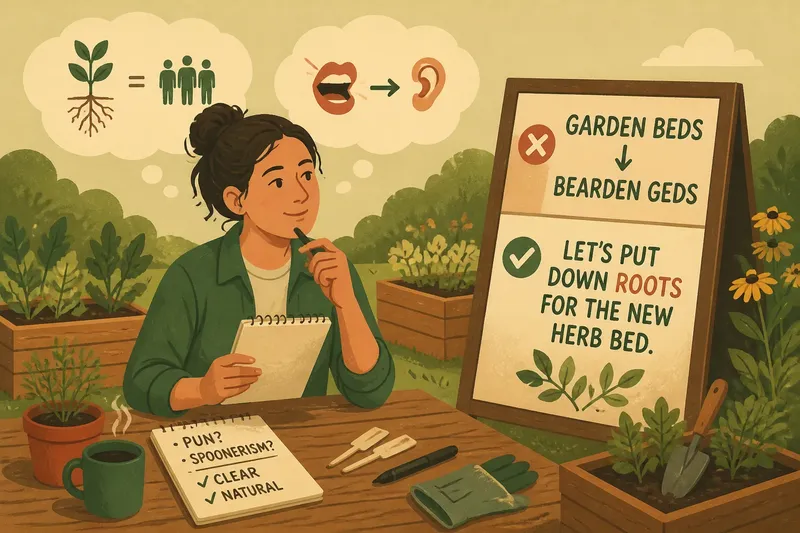
Imagine a volunteer writing a garden sign and weighing two drafts: “The beds are ready for planting” and a sound-swapped version made from “garden beds”. First, they read both aloud and find that the altered phrase is unclear. They then try the pun “Let’s put down roots for the new herb bed.” They check that roots refers both to plants and to settling in, and that the sentence still sounds natural as an invitation. The pun fits the sign’s friendly purpose; the failed sound swap does not. That choice keeps the message readable without forcing a joke into it.
Fit the audience
A pun can work well in a caption or sign because readers can pause over its spelling and revisit a word. A spoonerism usually relies more on hearing the phrase, so it may suit spoken dialogue or a brief exchange. Neither form is automatically clearer: unfamiliar vocabulary can obscure a pun, while an obscure source expression can leave a spoonerism stranded.
Consider the audience’s likely vocabulary and pronunciation. If the line depends on a specialist term or a particular accent, give enough context to make the turn legible, or choose a more widely recognised phrase.
When a draft feels muddy, name the intended mechanism before changing words. Ask whether the surprise comes from a second meaning or from exchanged sounds; then revise only the part that blocks that turn. For puns and spoonerisms alike, a small, well-placed surprise is easier to enjoy when the sentence still does its ordinary job.