Before the Eraser: How Reversible Writing Took Shape
Reversible writing is not just about erasers. Follow how reusable surfaces and graphite offered different ways to revise a mark, and choose a tool for the page.
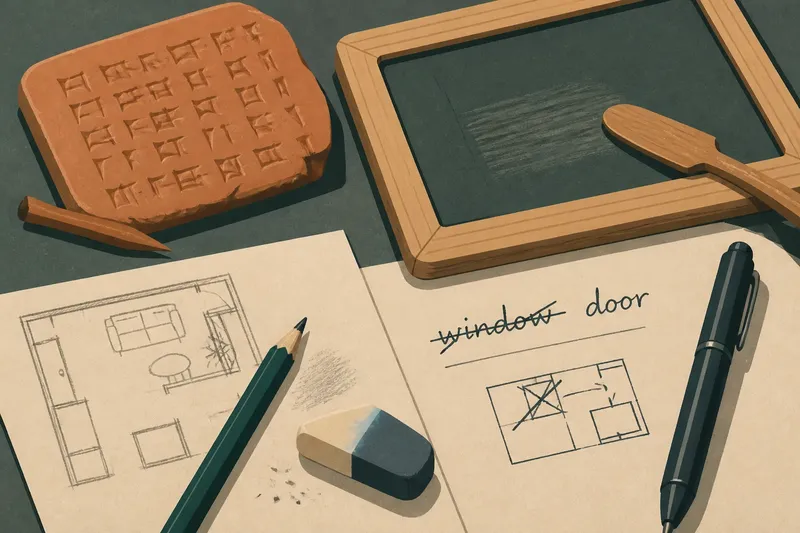
The common mistake is to treat the eraser as the beginning of reversible writing. Reversible writing is older than the familiar pencil-and-eraser pair: people could remove marks by changing the surface itself. That difference helps explain the history of reusable tablets, graphite and the later effort to make pen marks easier to revise.
Reusable surfaces came first
Some early writing methods made revision possible by letting writers reuse the writing surface. Clay could be reshaped while workable; wax on a tablet could be smoothed and marked again. These examples are broad historical patterns, not a single sequence followed everywhere. Materials and practices varied across places and periods.
Neither method worked like rubbing a mark off a modern sheet of paper. With clay or wax, the writer altered the surface that held the writing. The tablet remained useful, but the original wording did not necessarily remain visible.
Say you are using a wax tablet to keep a temporary list and one entry changes. You smooth the relevant patch with a flat tool, then write the replacement there. The expected result is a cleared space on the same tablet, not a pristine paper surface.
Ask whether the mark or the surface is meant to be reused.
Paper changes the problem
Paper made writing portable, but it also changed the cost of correction. Ink could soak into or cling to the sheet, while scraping or rubbing might disturb the paper itself. Unlike a wax tablet, a sheet was not designed to be smoothed and written on repeatedly.
Writers could still correct ink by crossing out a word, writing over it or replacing the sheet. Each option suited a different purpose. A visible correction can preserve what changed; a fresh sheet can make a finished copy look cleaner, but takes more work.
Imagine you are drafting a short note in ink and notice a wrong name. If the note is informal, draw one clear line through the error and write the correction beside it; the expected result is that both the old and new wording remain readable. If the page needs to look polished, rewrite it rather than trying to hide the change.
Graphite offers another route
The everyday graphite pencil developed gradually. Pencil forms and materials differed, and the familiar tool was not a single invention that appeared fully formed. Graphite proved useful because it left a visible mark on paper that could often be rubbed away more readily than ordinary ink.
An eraser works by dislodging or gathering some graphite from the paper’s surface. It cannot promise to restore the sheet exactly: a faint trace may remain, and forceful rubbing can roughen or weaken the paper. The pencil made revision easier, but did not make every correction invisible.
For a light graphite line, use a soft eraser with gentle strokes. If the paper begins to roughen or the mark remains, stop rather than rubbing harder.
Pen marks and reversibility?
Why does pencil erase?
Graphite rests on and between the upper fibres of paper, so an eraser can lift away some of it. The result depends on the mark and the sheet; a shadow or surface wear may remain.
Can ordinary ink be erased?
Ordinary ink usually cannot be rubbed away like graphite. Crossing it out, covering it or scraping the paper changes the page and may leave a visible trace.
What does erasable ink do?
Erasable ink is designed to make certain pen marks removable by a method specific to the product. Check its label and instructions, especially if the writing needs to remain stable as a record.
Why does paper affect correction?
Paper differs in texture, coating and strength, which affect how it takes a mark and responds to rubbing. Test a correction method on a spare piece of similar paper if the sheet matters.
Choose by intended use
Writing tools signal different expectations. A pencil suits a draft or sketch that may change. A permanent pen suits writing meant to remain legible, while a wipe-clean marker belongs on a reusable board. These are practical tendencies, not fixed rules.
- Observation: the wording is still a draft. If you expect frequent edits, use pencil; otherwise, choose a medium suited to the finished record.
- Observation: the page is a temporary calculation. If you can use a reusable board, write there; otherwise, use a sheet you can replace.
- Observation: the paper is thin or delicate. If rubbing visibly roughens it, stop erasing and rewrite on another sheet; otherwise, continue gently.
- Observation: the note must preserve the original correction. If both versions need to remain visible, cross out the error with one line; otherwise, make a clean replacement copy.
- Observation: the record must remain stable. If erasable ink is not explicitly suited to that purpose, use an appropriate permanent medium; otherwise, follow the product instructions.
- Observation: a shared planning surface will be reused. If it is designed for wipe-clean markers, use one; otherwise, choose a surface and medium that can be revised without damage.
Imagine you have a paper sketch of a room layout, a soft pencil, an eraser and a permanent pen. First, draw the furniture lightly in pencil because positions may change. Next, move a chair outline and erase the old position; if the paper starts to roughen, stop and redraw on a fresh sheet. Once the arrangement is settled, trace the chosen layout in pen only if you want a more durable version. The trade-off is clear: pencil supports revision, while pen makes the settled plan easier to distinguish from tentative marks.
Reversible writing describes a sequence of design choices, from reworking a surface to lifting graphite and formulating ink for removal. Its history is not a simple march towards perfect erasure. When choosing a tool, reversible writing is best understood as a question about what should happen when the words change: reuse the surface, alter the mark, or preserve the correction.