How to Solve a Misleading Riddle Clue Without Forcing an Answer
Solve a misleading riddle clue by separating stated facts from imagined details, mapping each phrase to candidates and spotting answers that need a stretch.
The most common mistake with a misleading riddle clue is committing to the first scene it suggests. That can make you overlook a small phrase that points elsewhere. Treat the first impression as a candidate, not a verdict.
Separate facts from scenery
A riddle gives you words; your mind supplies a scene. Keeping those apart is a useful starting point. If a clue says something “travels”, for instance, it has not necessarily said that the subject has legs, a driver or a destination.
Write down the exact phrases before interpreting them. Then mark which details are stated and which you inferred. This prevents an imagined setting from quietly becoming part of the clue.
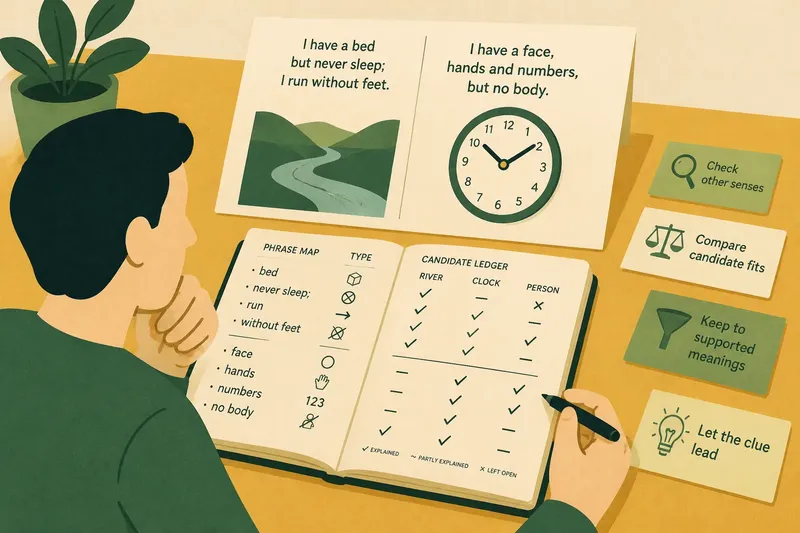
Say you are given the invented clue, “I have a bed but never sleep; I run without feet.” The stated details are a bed, no sleep, running and no feet. “A busy person” might account for running, but the clue gives no reason for that person to have a bed. A river can have a riverbed and run along a course, so it connects the phrases without needing an extra scene.
Map each phrase
Instead of collecting every possible meaning for every word, make a small phrase map. Put each clue fragment on a separate line, then note the kind of thing it might describe: an object, an action, a shape, a function or a familiar expression.
For example, “has hands” might describe a body part or the pointers on a clock. “Runs” might describe movement or operation. The surrounding words decide which possibilities deserve attention; a dictionary list on its own does not.
- Grammar: If a word’s alternative sense does not fit its role in the sentence, keep the ordinary reading or set that candidate aside.
- Object and action: If the clue could describe either a thing or what it does, test both; if one leaves another phrase unexplained, return to the other.
- Literal and figurative: If a figurative meaning suits the wording naturally, compare it with the literal one; if it needs a strained expression, do not build an answer on it.
- Phrase meaning: If two words form a familiar expression, check that combined sense; if the phrase is not supported by the rest of the clue, favour a plainer reading.
- Number: If singular or plural wording points to a particular count or group, retain that distinction; if a candidate requires changing it, look for another answer.
- Unstated detail: If a candidate depends on a place, object or event the clue never mentions, ask whether the wording independently supports it; if not, treat that candidate as weaker.
The map is a filter, not a hunt for cleverness. A less familiar sense needs clear support from the neighbouring words.
Compare candidate fits
Try a short phrase ledger rather than repeatedly rereading the clue as a whole. Give each candidate a note beside every phrase: explained, partly explained or left open. This shows where an attractive answer is doing real work and where it relies on guesswork.
Imagine an invented clue: “I have a face, hands and numbers, but no body.” Start with the written facts: face, hands, numbers, no body. Candidate one is a person described figuratively; it accounts for a face and hands, but the numbers and missing body need extra explanation. Candidate two is a clock; its face displays numbers, its hands indicate the time, and it has no body in the human sense. The clock is the stronger answer because the three object-related phrases converge on one reading. It is not necessary to invent a room, a person or a story around it.
Use the ledger to spot the one phrase that separates two plausible answers. If both explain most of the clue, give that phrase more weight than a clever fit with a single word. If neither accounts for it naturally, the clue may not supply enough information to settle the answer.
When should you change readings?
Which word deserves a second look?
Start with the word that makes the clue feel odd or creates the strongest mental picture. Ask whether another everyday sense fits the sentence’s grammar and the nearby phrases. An unusual word is a prompt to check, not proof of a trick.
Should the literal reading stay in play?
Yes. A literal reading may explain some or all of the clue, so keep it beside the alternatives. Drop it only when another candidate accounts for the wording more naturally.
What if two answers fit?
Mark the phrases each answer leaves open, then identify what extra wording would distinguish them. If both remain equally plausible, accept that the clue may be underspecified rather than forcing a choice.
When is a wordplay reading too strained?
It is strained when it breaks the grammar, depends on an obscure sense without a hint or explains only one isolated word. Prefer an alternative that the surrounding wording makes available.
Stop at supported meanings
Keep the search bounded. Consider ordinary meanings and familiar figurative uses that fit the grammar, then compare the strongest candidates in the phrase ledger. If an answer needs a private code or a chain of unhinted associations, it has probably travelled farther than the clue allows.
For a misleading riddle clue, the most useful final check is to read each phrase with your chosen answer and note what it actually explains. Leave unresolved wording visible instead of smoothing it over. That small discipline makes a sound answer easier to recognise—and an ambiguous clue easier to call ambiguous.